The tale The Young Woman and the Candle belongs to a recurrent category of Luso-Brazilian folklore: cautionary narratives primarily directed at youth, especially young women, in which disobedience to familial advice results in direct contact with the supernatural.
In these stories, certain domestic spaces take on a symbolic function. The window, in particular, frequently appears as a transition point between the protected interior of the house and the nocturnal exterior, associated with danger, the unknown, and the circulation of so-called "wandering souls." Remaining at the window at ungodly hours is not described as mere distraction, but as an imprudent attitude capable of exposing the individual to that which does not belong to the everyday world.
The disturbing element of the tale does not lie in physical aggression, but in the rupture of normality. A common object —the candle— is transformed into an unequivocal sign of death. The horror is not immediate: it settles in slowly, starting from the initial indifference of the young woman, her disbelief in maternal warnings, and the banality with which she accepts the stranger's request.
The version presented here is based on the records of Luís da Câmara Cascudo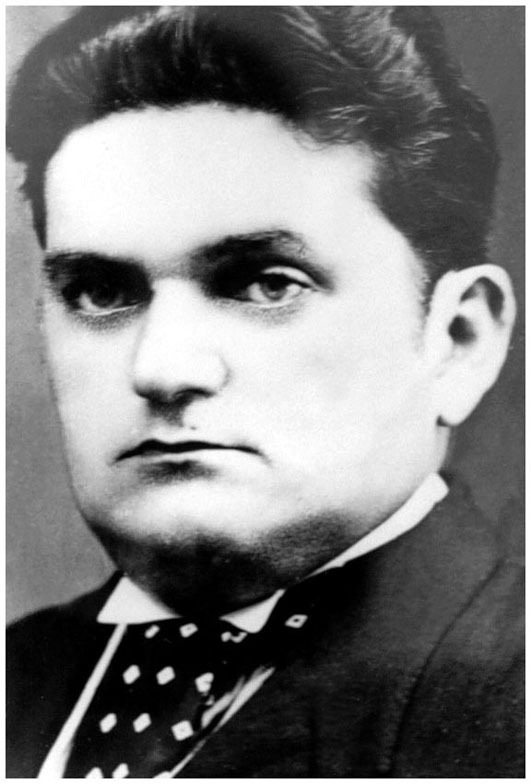 in Contos Tradicionais do Brasil, preserving the exemplary structure of the narrative: the ignored warning, the nocturnal encounter, the final revelation, and the lasting consequence. The conclusion does not point to corporal punishment, but to the loss of one's mind—a frequent solution in folk narratives when contact with the beyond exceeds the limits of the bearable.
More than a ghost story, it is a report with a clear moral function, transmitted as a warning. In the logic of traditional folklore, there are times, gestures, and places that demand respect—and ignoring them can cost more than a fright: it can cost one's reason.
The Young Woman and the Candle — Based on Luís da Câmara Cascudo
Text edited and rewritten by Marcelo Amado.
There was a young woman who had a habit of staying at the window until all hours of the night.
— My daughter — her mother would say —, those who stay at the window until late see things they shouldn't see. This is an example from the old folks who knew more than we do.
— Nonsense! — the girl would say —, I've never seen anything startling. I'm not sleepy, and I won't go to bed with the chickens.
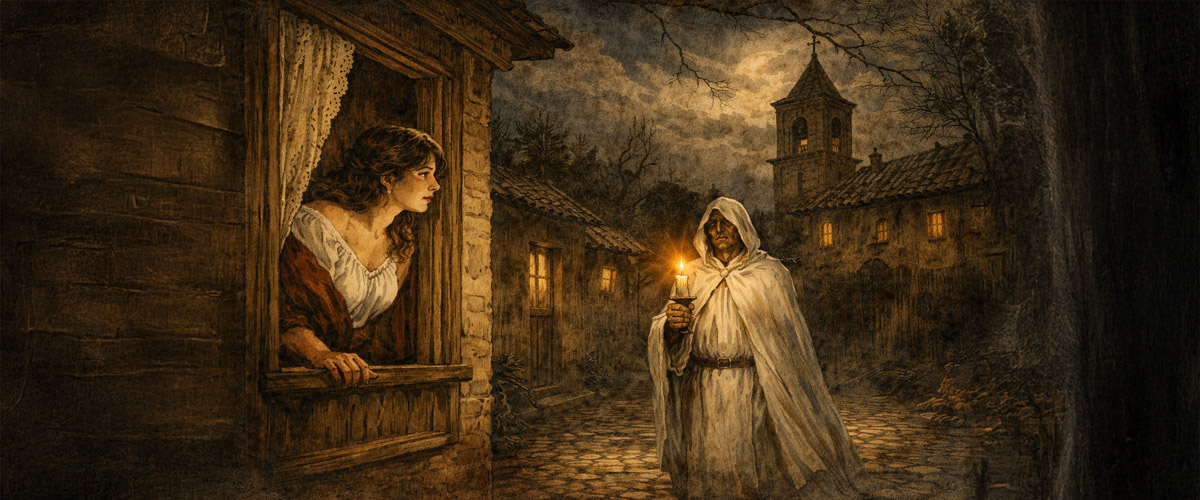
Her mother always repeated the advice, but the girl, hoping to find a suitor, continued her habit. Once, the stubborn girl was at the window when, as the last stroke of midnight sounded, she saw a figure wrapped in a stark white habit approaching, walking with hurried steps and carrying a lit candle in one hand.
The girl was so distracted, thinking of her loves and the one she awaited, that she felt no fear. It was as if she had seen nothing. The stranger greeted her and, blowing out the candle, asked her to keep it until his return. Mechanically, the young woman went to place the candle on her bed, and when she returned, the stranger was gone.
She didn't even remember her mother's advice, and the apparition did not disturb her in the least. She remained at the window, preoccupied only with her thoughts and loves. At two in the morning, which is when wandering souls retire, she was still enjoying the night. The stranger arrived quickly and asked for the candle. The girl went to fetch it from the bed but let out a scream of horror. Instead of a candle, there was a skeleton stretched out on the bed.
The skull rose and, before her eyes, drifted out the window as if it were a light feather. From that day on, the girl became simple-minded. She laughed and cried for no reason and became an example for all disobedient daughters in the town where this case took place.