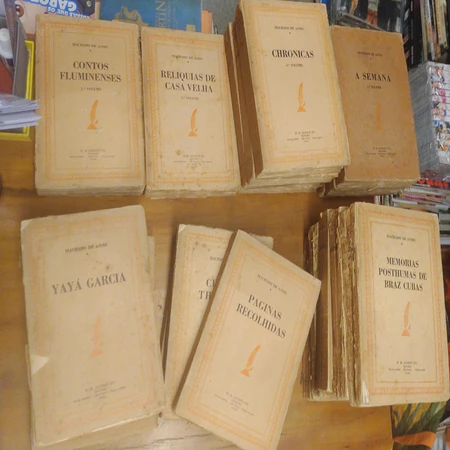
This article opens the gates to the Shadows of Folklore series. Its task is to traverse a specific and seldom-visited territory: that where Brazilian authors took narratives of popular origin —legends, folk tales, regional traditions— and transformed them into literary tales of a fantastic, unsettling, or dark nature. It is not about folklore as a record or ethnographic curiosity, but about folklore already crossed by writing, molded by literary form and subjected to aesthetic intent.
Here, the starting point is not songs, explanatory myths, or festive and identity manifestations. What interests us are texts: short stories, reports, and short narratives published by writers who collected, adapted, and recreated stories from the Brazilian popular imagination. Works such as O Pão d’Ouro, by Bernardo Guimarães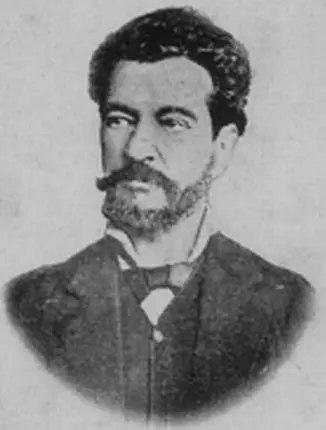 ; The One-Eyed Moor, by Sílvio Romero
 ; or Contos Amazônicos, by Inglês de Sousa —among others yet to be revisited— do not appear as simple echoes of oral tradition, but as literature conscious of its means: language, rhythm, atmosphere, and point of view.
These texts reveal a particular aspect of Brazilian folklore: that which leans toward the fantastic, the strange, and the unsettling. They are narratives populated by deformed figures, ambiguous enchantments, cruel punishments, apparitions, and inexplicable forces that burst into daily life without announcement and without explanation. The fear born from this is not spectacular. It is low, persistent, insinuated —often dry, abrupt, almost indifferent to the reader.
The Shadows of Folklore series focuses precisely on this intermediate territory: the moment when folklore ceases to be mere oral tradition and begins to exist as dark literature, capable of provoking discomfort, estrangement, and unease. When fixed on paper, these stories harden. They often become more cruel. And they begin to reveal not only the fear of the supernatural, but also the social, moral, and cultural tensions of 19th and early 20th-century Brazil.
Throughout the articles, works by authors who produced texts from this popular imagination will be brought to the surface. In the case of Sílvio Romero, for example, brief tales like The One-Eyed Moor demonstrate how traditional materials are reorganized into dry, direct, and sometimes brutally effective narratives —stories in which the fantastic emerges without ornament and without consolation.
It is not the intention of this series to classify these texts as "horror" in the modern sense of the term. What is sought is to highlight how they build a Brazilian form of unsettling narrative, rooted in local legends, regional beliefs, and everyday situations. A fantastic that does not depend on excess, but on distorted familiarity; not on spectacle, but on the persistent feeling that something, there, is out of place.
Nor is it the goal of this series to analyze texts, study authors, or assume any didactic or educational direction. The proposal is different: to bring back to light works of our literary culture that many readers may never have known —or that, over time, ended up buried by memory.
These are narratives that circulated, were published, read, and then silenced by forgetfulness. Here, they return not to be explained, but to be rediscovered. Like stories that are told again not to teach, but to unsettle, provoke, and remain.
Shadows of Folklore thus proposes a close approach to these tales —not as folkloric curiosities, but as literature that makes fear, the strange, and discomfort its central elements. Short texts, sometimes crude, but charged with an unsettling force that reveals how the Brazilian popular imagination, through writing, was capable of generating dark, harsh, and deeply disturbing narratives.
Lest the reader leave these pages in suspense, waiting in silence for the next call of this series, I have chosen not to end the journey here. Since we spoke of The One-Eyed Moor —one of those narratives that traversed time without ever becoming harmless— we present it below in its full form. Let the text speak for itself, as it always has, and let each reader find in it that which they thought forgotten… or perhaps that which should never have been awakened.
The One-Eyed Moor - Sílvio Romero
Taken from the eBook Sílvio Romero: Contos Populares do Brasil - Cadernos do Mundo Inteiro, a very cool project to visit.
Once there was a father who had three sons, and, having nothing else to give them, gave each one a watermelon when they wanted to leave home to earn their living. The father had recommended that they not open the fruits except in a place where there was water. The eldest of the youths, when he went to see what his fate would bring, while still near the house, could not contain himself and opened his watermelon. Out jumped a very beautiful girl saying: "Give me water, or give me milk." The boy found neither one nor the other, the girl fell back and died.
The middle brother, when his turn came, being not far from home, also opened his watermelon, and out came a girl even more beautiful than the other; she asked for water or milk, and the boy finding neither, she fell back and died.
When the youngest set out to earn his living, he was smarter and only opened his watermelon near a spring. Upon opening it, out jumped a girl even more beautiful than the first two, and she said: "I want water or milk." The youth went to the spring, brought water, and she drank her fill. But the girl was naked, and so the boy told her to climb a tree near the spring while he went to fetch clothes for her. The girl climbed up and hid in the branches.
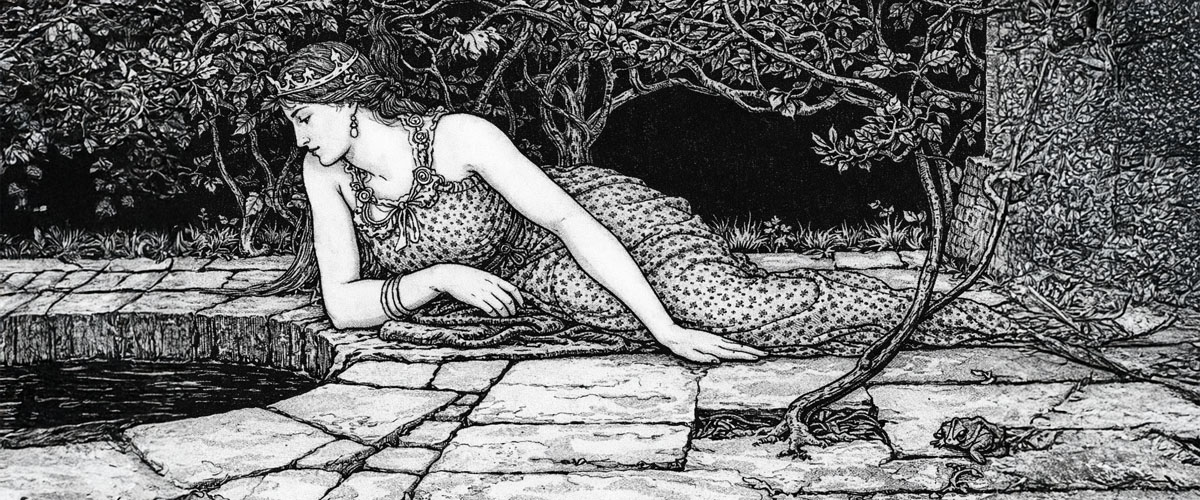
A one-eyed Moor came to fetch water, and seeing in the water the reflection of such a beautiful girl, she thought it was her own and began to say: "What nerve! For I, being such a beautiful girl, to be carrying water!..."
She threw the pitcher on the ground and smashed it. Arriving home without water or pitcher, she received a very sharp scolding, and the lady sent her to fetch water again, but at the spring she did the same and broke the other pitcher.
The third time she did the same, and the girl, unable to contain herself, burst into laughter. The one-eyed Moor, startled, looked up and said: "Ah! It’s you, my little granddaughter!... Let me pick a louse from you."
And she immediately climbed up the tree and went to pick at the girl's head. She stuck a pin into her, and the girl turned into a little dove and flew away! The one-eyed Moor then stayed in her place.
The youth, when he arrived, found such a great change and was puzzled, but the one-eyed Moor said to him: "What do you want? It was the sun that burned me!... You took so long to come fetch me!"
They left for the palace, where they were married. The little dove then used to fly near the palace, and would perch in the garden saying: "Gardener, gardener, how goes the king, my lord, with his one-eyed Moor?" And she would flee.
Until the gardener told the king, who, somewhat suspicious, ordered a diamond snare set to catch her, but the little dove did not fall. He ordered a gold one set, and nothing; a silver one, and nothing; finally one of birdlime, and she fell. They took her to the king, who greatly appreciated her.
Some time later, the one-eyed Moor feigned pregnancy and demanded all sorts of things just to eat the little dove. On the day she was to be put in the pot, the king, with pity, began to groom her and found that little lump on her head, and thinking it was a flea, he pulled it and out came the pin. Out jumped that girl as beautiful as love itself.
The king recognized his beautiful princess. They were married, and the one-eyed Moor died tied to the tails of two wild donkeys, split down the middle.







![Tênebra: narrativas brasileiras de horror [1839-1899]](/media/advertisements/advertisement_banner_110.jpg)