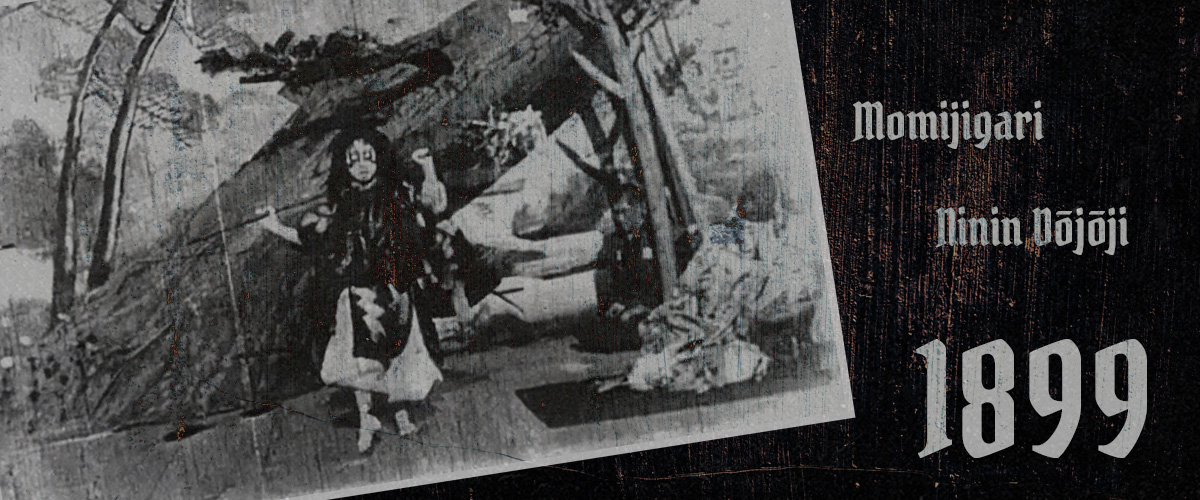
While early European cinema played with devils and visual tricks, Japanese cinema began bringing centuries-old haunted stories from theater and folklore to the screen. Fear here is cultural memory. These are not proto-horror1 by accident. They are horror by heritage.
These films make one thing very clear: horror in cinema was not born solely from grotesque imagery, monsters, and demons. It also came from the narrative tradition that cinema inherited from other arts and popular legends.
We have two examples: Momijigari and Ninin Dōjōji, both 1899 productions directed by Tsunekichi Shibata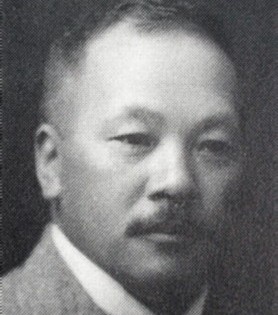 .
.
Momijigari
Often cited as the oldest preserved Japanese film (though in fragments), it is considered one of the pillars of Japanese cinema.
It was not conceived as a narrative cinematic work, but as a performance record — something common in early Japanese cinema. Even so, it became a milestone.
The film records a famous kabuki play starring Ichikawa Danjūrō IX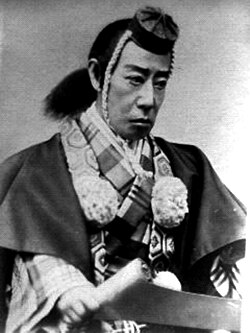 , one of the greatest names in Japanese theater. In the play, a warrior encounters a mysterious woman while viewing autumn leaves. Gradually, he discovers she is a demon in disguise, trying to bewitch him. The final confrontation involves possession, monstrous revelation, and ritual violence — elements that clearly belong to the universe of kaidan (ghost stories).
In the short, the warrior Taira no Koremochi is seduced by a princess with dance and sake, leading him into an enchanted sleep. However, a deity sends a mountain god to warn the warrior, revealing that she is a demon in disguise. Armed with a sacred sword, Kogarasu Maru, Koremochi faces the creature in a symbolic duel between the human and the supernatural.
Visually, everything is still theatrical, frontal, and static. But the content — a demon hidden under human form — is pure folk horror.
Shibata filmed the scene in November 1899, using a camera imported from Gaumont, in an open space behind the Kabuki-za in Tokyo, with famous actors Onoe Kikugorō V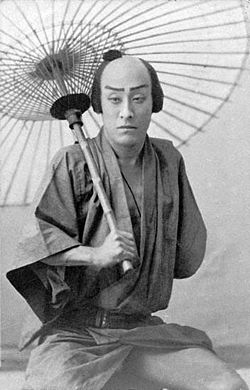 and Ichikawa Danjūrō IX.
Records indicate that although produced in 1899, it was only revealed to the public after the death of Ichikawa Danjūrō — which occurred in September 1903, due to an agreement made with the actor.
(Recovered fragments can be watched here)
Ninin Dōjōji
Along with Momijigari, this film was also a milestone. Unfortunately, it is completely lost — not even fragments have been found.
It belongs to the universe of the ancient legend of the Dōjōji temple and the supernatural transformation of a woman into a furious serpent due to unrequited love.
The central story is that of Kiyohime, a young woman who falls in love with a monk named Anchin. Rejected, she transforms into a demonic serpent and pursues him to the Dōjōji temple. There, she coils around the temple's huge bell and melts it with rage, killing Anchin under the weight of her own mythical fury.
Shibata's work is not a “horror movie” in the modern sense — but it captures a performance loaded with symbolism. Even though filmed in a theatrical manner, the content speaks of forces that do not belong to the rational world.
Technical records indicate that Ninin Dōjōji was probably one of the first Japanese films to be colored by hand tinting, done by the Yoshizawa Company — an important detail about the technical processes of early cinema in Japan.
Further proof that myths and legends served as food for the soul of the cinematic horror genre.
The aesthetics would come later.
Research sources: Kabuki 21, iMDB, Moviegoings, Who's Who of Victorian Cinema