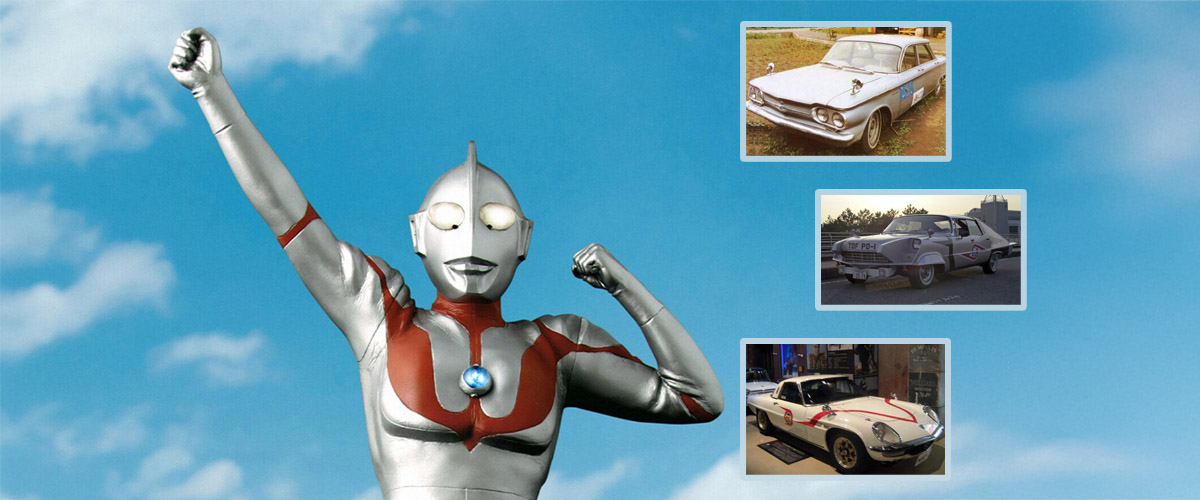
Ultraman and three of the vehicles from the classic series
Tsubaraya Productions
Ultraman is one of the pillars of Japanese tokusatsu . Produced by Tsuburaya Productions, the franchise spans decades combining giant heroes, bizarre monsters, practical effects and, something that has always caught the attention of children (and many adults too): incredible machines. Between futuristic jets and unlikely tanks, the cars used by the defense teams ended up becoming an essential part of the Ultra Series identity.
The so-called “Showa era” — from the late 1960s to the early 1980s — coincides with the boom of the Japanese automobile industry. This meant that many real vehicles, newly launched or technologically advanced, were incorporated into the series as patrol, attack or scientific support cars. Next, a tour of the main automobiles that marked the first Ultraman entries.
Ultra Q (1966) and Ultraman (1966)
The franchise started with Ultra Q, a science fiction series focused on mysteries and monsters, still without the presence of a superhero. Soon after came Ultraman, presenting the warrior from Nebula M78 who comes to Earth to hunt the space monster Bemular and ends up assuming the mission of protecting the planet.
A curious detail of this phase is that the popularization of color television in Japan is frequently associated with the success of Ultraman, which quickly became a fever among children.
Chevrolet Corvair 1963
Chevrolet Corsair 1963: on the left in a scene from the Ultraman series; on the right in an American advertisement for the vehicle.
The first remarkable car of the franchise was not futuristic nor specially modified. The SSSP (Science Special Search Party) used a Chevrolet Corvair practically from the factory, with only a few stickers applied.
The Corvair was already famous (or infamous) due to the book Unsafe at Any Speed, by Ralph Nader, which criticized its dynamic behavior. Behind the scenes, the reason for its use was much simpler: the car belonged to the production and served both for recordings and for the daily commute of the team.
A curious detail is that the Chevrolet Corvair appears with the steering wheel on the left side, something uncommon in Japan. This is explained by the fact that the car was an American import used practically without modifications, reflecting the improvisation and practicality of the first recordings of the series, which used the production's own car. And didn't it end up becoming one of the most remembered sidekicks to this day?
Toyopet Crown, a purposeful substitute?
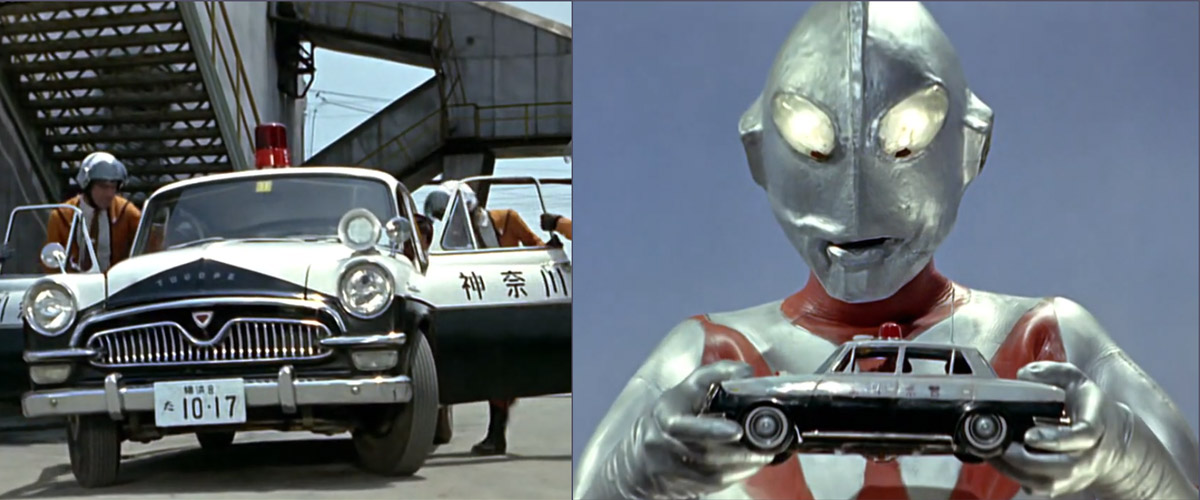
On the left, Toyopet Crown in the episode Cacau Beans. On the right, seconds later, Ultraman saves the team, pulling them out of the way of Gesura.
In episode 6, Cacau Beans (Engan Keibi Meirei), a curious detail stands out: the team appears using a different car than usual. Instead of the Chevrolet Corvair, a Toyota Crown appears on scene, probably from the early 1960s — a period in which Toyota still marketed its automobiles under the name Toyopet.
There is no official confirmation about the reason for this swap, but there is a very plausible explanation linked to production needs. In this episode, there is a scene in which Ultraman literally holds the car to save the team during the attack of the monster Guesra (or Gesura), which required the use of a very detailed miniature.
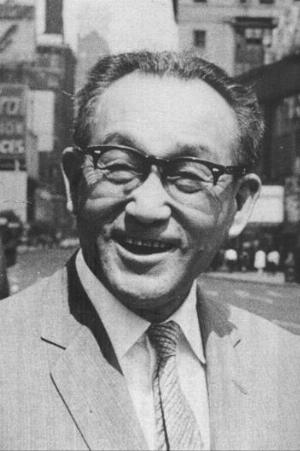
The Chevrolet Corvair, being an imported car and relatively rare in Japan at the time, represented a practical problem: there were no ready-made miniatures available in proper scale for Tsuburaya Productions' cameras, and manufacturing one from scratch would be expensive and time-consuming. On the other hand, the Toyopet Crown was an extremely common national car, widely reproduced in toys and models of various scales. For the special effects team — led by the legendary Eiji Tsuburaya — it was much simpler, faster and cheaper to purchase a ready-made Crown miniature and adapt it with the colors of the Science Patrol than to build a Corvair in scale from the beginning.
Within the narrative, the change is justified in a simple way: it is a vehicle borrowed from the local police. Still, everything indicates that this explanation served more as a script solution for a technical problem than as a planned creative decision.
It is worth reinforcing: this is not official information, but a logical reading based on the production practices of tokusatsu from the 1960s. Especially since other vehicles also appear punctually in different episodes of the series, whenever the needs of special effects spoke louder.
Ultraseven (1967)
In the next series, Ultraseven (Urutorasebun), aired between October 1, 1967 and September 8, 1968, with a total of 49 episodes, the production decided to invest in an exclusive vehicle, created specifically for the series. However, it brought a bit of a headache for the production.
Pointer (Chrysler Imperial 1957)
Pointer TDF PO-1, the patrol car adapted from a Chrysler Imperial, 1957
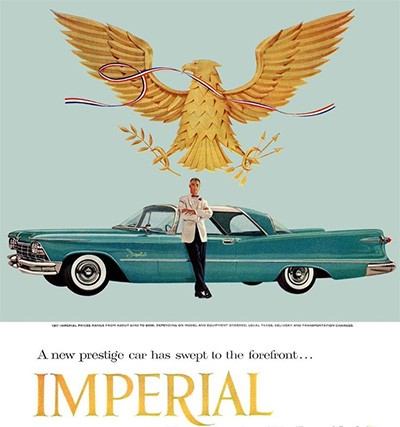
In the opinion of some die-hard fans, the Pointer has become one of the most iconic cars in the history of tokusatsu, comparable to the 1966 Batmobile in terms of visual recognition. Its base was a 1957 Chrysler Imperial (see image of the advertisement), but the modifications were essentially aesthetic. The car was in terrible mechanical condition during filming, did not actually work and had to be pushed or towed in the action scenes. Still, it went down in history as a symbol of the series. In the image to the side, an advertisement from the time of the Chrysler Imperial launch. But let's see what was special about this iconic patrol car:
Top speed: 365km/h on ground, and 80km/h in flight mode;
Smoke curtain device: the pointer can release smoke to escape from enemies;
Small jet engine: this engine allows the car to fly through the air;
Light wave barrier system: an energy barrier used to avoid attacks;
Ultra missile: three double missile launchers, two of which are mounted on the rear of the vehicle's body;
Perspective light: installed on the front part of the vehicle's body;
Smoke injection device is also present on the side;
Hover system: used in conjunction with the jet engine to fly, the system allows the car to hover. It can also fly for a short period and even over water;
Special rubber tires: special tires made of durable and puncture-resistant rubber;
Ray cannon: equipped on the front grill of the car.
The Return of Ultraman (1971)
The story starts after the departure of the original Ultraman, when Earth once again faces monsters and alien threats. Then emerges Ultraman Jack, sent by Nebula M78 to protect the planet.
Unlike previous series, the plot combines action elements with investigations by the MAT (Monster Attack Team) team, which uses futuristic vehicles and advanced technology to face monsters. Among the highlights, the Mazda Cosmo Sport, MAT's elegant patrol vehicle, symbolizes the modern and futuristic spirit of the series.
Mazda Cosmo Sport (1967)
MAT Team Cosmo Sport
Launched in 1967, the Cosmo Sport was the first Japanese car to use a production Wankel rotary engine. Its two-rotor, 1-liter engine yielded about 110 hp at 7,000 rpm, offering smooth acceleration and an extremely futuristic look for the time — a perfect combination for a science fiction series.
The success of the Cosmo helped consolidate the image of rotary engines, which would later appear in other Mazda models like Familia, Capella and Savanna.
On the MAT team car, externally, there is not much difference from the real model. However, the little fellow was equipped with a driver's seat that had a high-performance communication device, radar and detection equipment. The roof had warning lights. In addition, it could be equipped with a 30-shot rocket launcher to participate in ground combat missions.
Ultraman Ace (1972)
Ultraman Ace (Urutoraman Ēsu), is the fifth series of the Ultra franchise ─ if we count Ultra Q ─, exhibited between 1972 and 1973, and marks an important change in the tone of the stories. After the departure of Ultraman Jack, Earth starts to face an unprecedented threat: Yapool, an entity from another dimension capable of creating the so-called Terrible Monsters (Choju), creatures much more violent and resistant than traditional monsters.
To combat them, Ultraman Ace arrives from Nebula M78. Unlike his predecessors, Ace initially manifests through the fusion of two humans, Hokuto Seiji and Minami Yuko, symbolizing union and sacrifice. Later in the series, Yuko leaves Earth, and Hokuto starts to transform into the hero alone. The defense of the planet is the responsibility of the TAC (Terrible-Monster Attacking Crew).
Toyota Corona Mark II GSS – TAC Panther
On the left, the model from the series. On the right, an advertisement from the time.
The car of the Terrible-Monster Attacking Crew (TAC) was the elegant Corona Mark II GSS, renamed as Panther. The black paint with orange stripes and silver details dialogued with the design of the team's helmets. The Mark II was launched in 1968 as a more sophisticated version of the Corona, aiming at the public looking for comfort and performance. The GSS, in particular, brought a 2.0 DOHC inline four-cylinder engine, with about 145 hp, being quite popular among young Japanese at the time.
Big franchise, many cars...
The Ultraman franchise is gigantic and remains strong today. It would be impossible to mention all the cars that have appeared over the decades. For this reason, I decided that the article would only go as far as Ultraman Ace, because in my opinion, these first productions have the coolest and most interesting vehicles, and those that, in a way, marked my childhood.
These cars were not just background actors: they reflected Japan's technological progress, the growth of automotive culture and the dream of a future driven by science, speed and ingenuity. For many people, the first contact with iconic cars from the Japanese industry came precisely through the magic of Ultraman.
Creator of Estronho in 1996, one of the founders of Editora Estronho in 2011. He coordinated and edited numerous books about cinema and TV. He is a writer, author of Ele tem o sopro do Diabo nos pulmões and other titles. Currently working as a Senior Dev at Vintage Words Studio.
Links Patrocinados
Comprando com nosso link você ajuda a manter o projeto





 , the franchise spans decades combining giant heroes, bizarre monsters, practical effects and, something that has always caught the attention of children (and many adults too): incredible machines. Between futuristic jets and unlikely tanks, the cars used by the defense teams ended up becoming an essential part of the Ultra Series identity.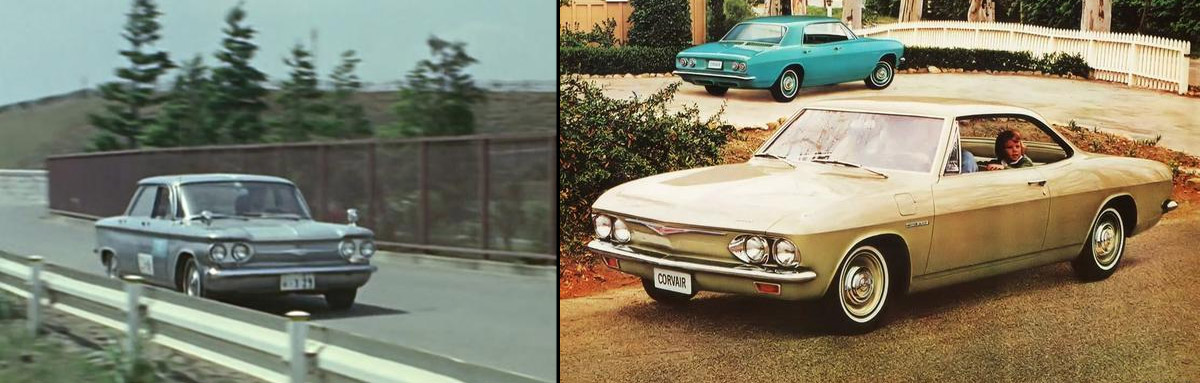
 — it was much simpler, faster and cheaper to purchase a ready-made Crown miniature and adapt it with the colors of the Science Patrol than to build a Corvair in scale from the beginning.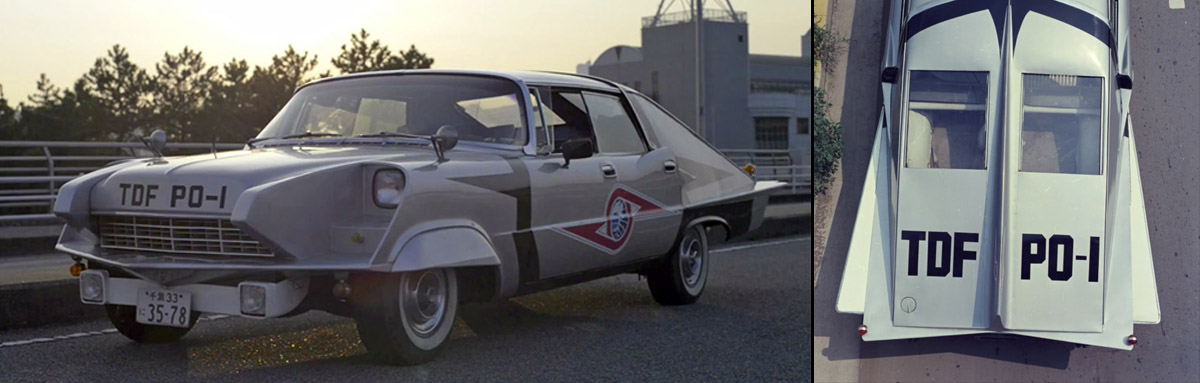
 In the opinion of some die-hard fans, the Pointer has become one of the most iconic cars in the history of tokusatsu, comparable to the 1966 Batmobile in terms of visual recognition. Its base was a 1957 Chrysler Imperial (see image of the advertisement), but the modifications were essentially aesthetic. The car was in terrible mechanical condition during filming, did not actually work and had to be pushed or towed in the action scenes. Still, it went down in history as a symbol of the series. In the image to the side, an advertisement from the time of the Chrysler Imperial launch. But let's see what was special about this iconic patrol car: