The year is 1974. Counterculture1 still echoes, colors are more saturated than ever, and you have a herculean challenge: put an average American family to run from dinosaurs in a parallel land, every Saturday morning, on the budget of a neighborhood diner.
A Family in the Time Portal
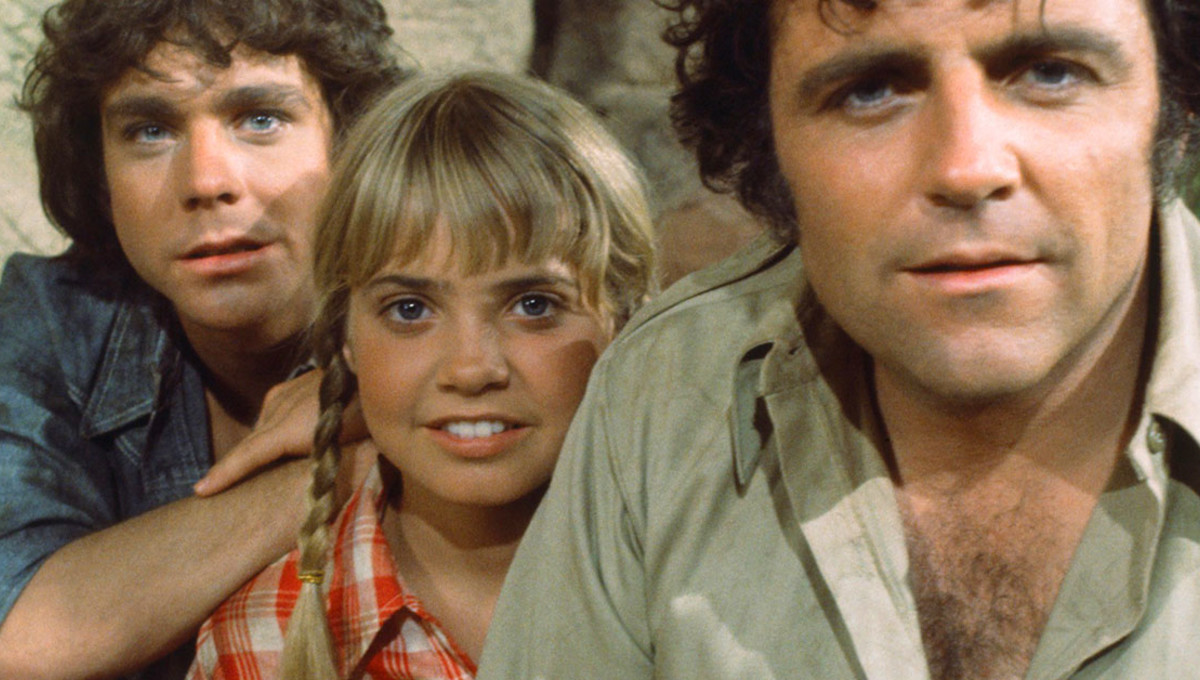
The premise of Land of the Lost (1974-1977) is an adventure classic: during a routine expedition, forest ranger Rick Marshall (Spencer Milligan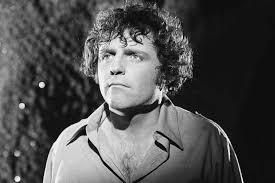 ) and his children, Will (Wesley Eure
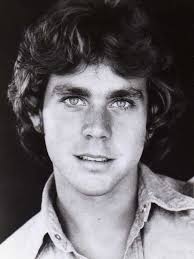 ) and Holly (Kathy Coleman
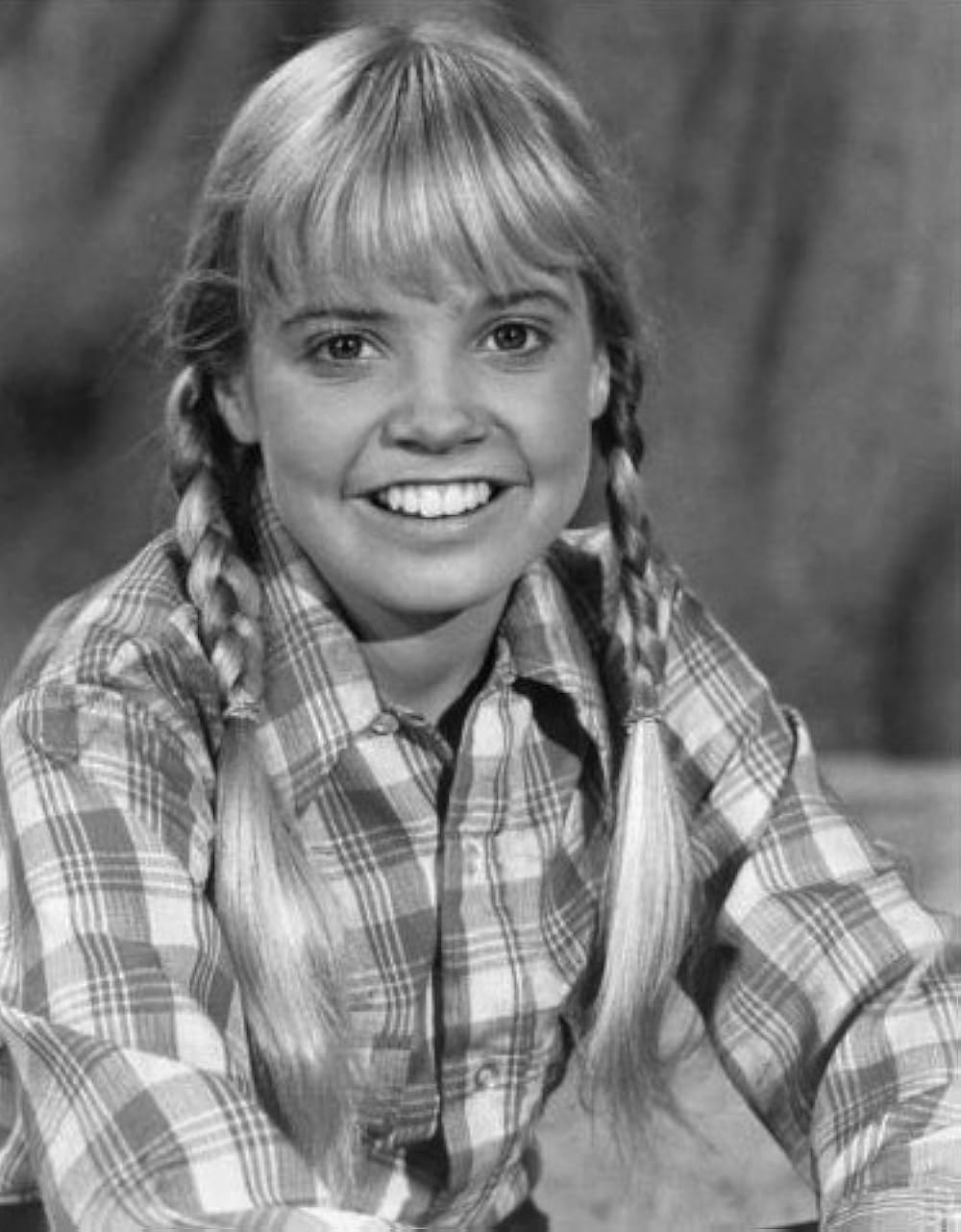 ), are caught by a colossal earthquake while white-water rafting in a canoe. They fall down a waterfall that leads not to the river, but to a space-time portal.
When they open their eyes, they are no longer in the Grand Canyon. They are in the "Lost World," an impossible ecosystem where three moons shine in the sky, ape-men called Pakuni try to communicate, and hissing reptilian creatures, the Sleestaks, lurk in damp caves. And, of course, there are dinosaurs. Lots of them. The Tyrannosaurus "Grumpy" isn't just a noisy neighbor; he is a constant threat that occupies half the screen.
Television Without Pixels
Excellent idea! But there’s a problem... it’s 70s television. CGI is still a distant dream in computer labs that take up entire floors. You don’t have a Hollywood budget, and you need to deliver a new episode every week.
Ah, but if you are one of the Sid and Marty Krofft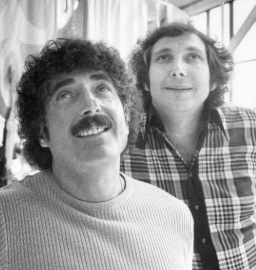 brothers, you aren't afraid of the ridiculous. You have Chroma Key, resin miniatures, and a lot, a lot of rubber.
A note to readers: if you are a paleontologist or an ILM visual effects master, this text might make you dizzy. We’re talking about dinosaurs that look like puppets (because they were) and forests that end abruptly in a blue light. If you seek scientific rigor, this is not your valley. But if you want to understand how imagination defeated the lack of pixels, pull up a seat.
The effects of Land of the Lost ─the fifth series created by Sid and Marty Krofft─ represent the triumph of imagination over reality. While Georges Méliès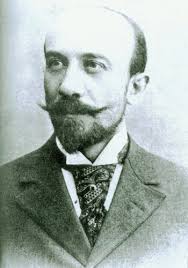 painted canvases to trick the eye ─as we saw in the previous article─ the Kroffts explored 1970s video technology to overlap and combine distinct worlds. The result was a “cut and paste” aesthetic that amplified the sense of fantasy and exaggeration, typical of the visual counterculture of the time.
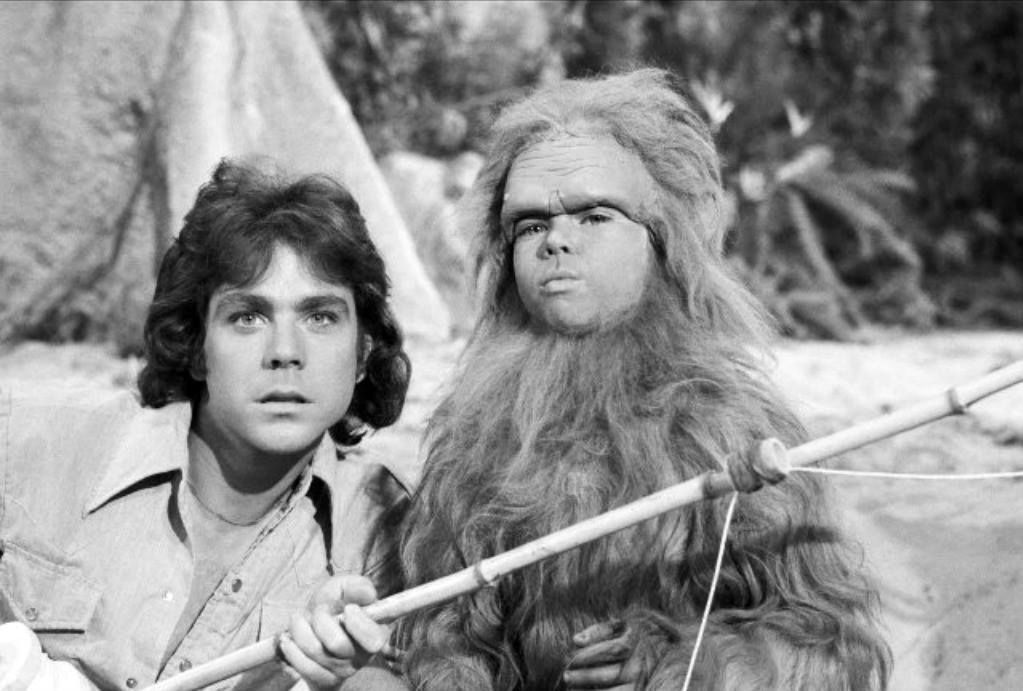
 (Cha-Ka). © 1974 NBC / Sid & Marty Krofft Television Productions.
Plastic Forests and Shaking Dinosaurs
The big trick was Chroma Key (the famous blue screen). Actors ran in an empty studio, climbing on styrofoam rocks, while models were inserted into another layer. The technology, however, was rudimentary: often a bluish “aura” appeared around the actors' hair, or a foot seemed to float above the floor. For a seven-year-old child in 1974, these details vanished before Grumpy’s roar.
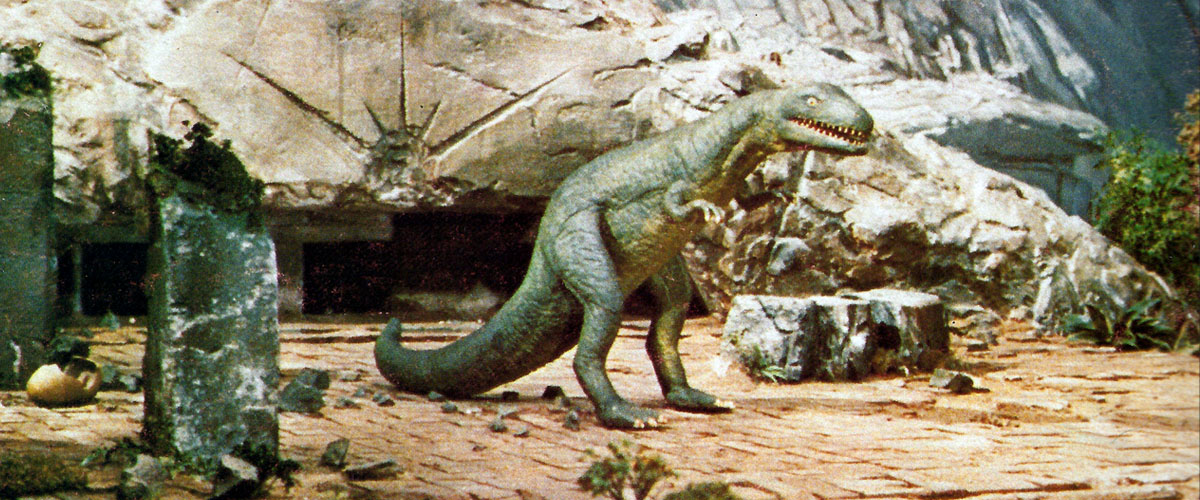
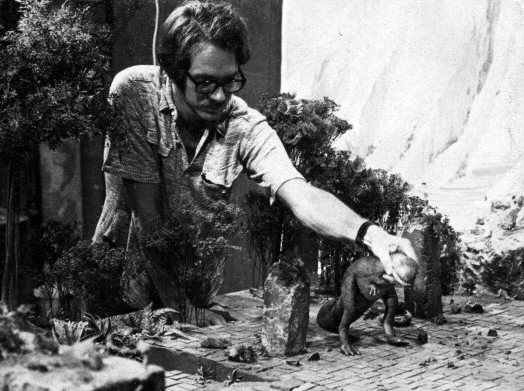
The dinosaurs came to life thanks to stop motion: articulated miniatures were moved millimeter by millimeter, requiring 24 adjustments for every second of footage. This slightly “shaky” movement gave the monsters a personality of their own, distinct from the cold realism of modern techniques.
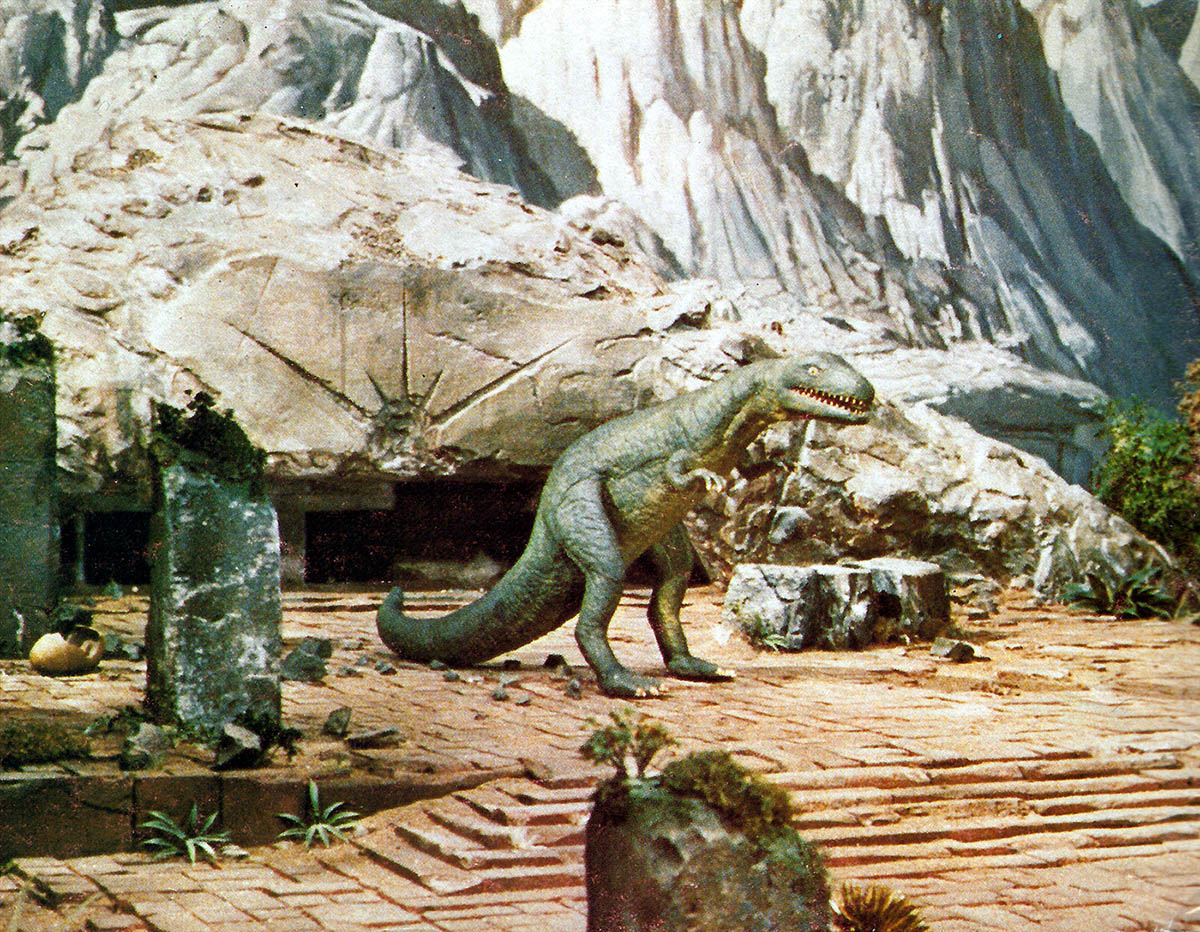
 . Photo: Cinefantastique Magazine Vol. 6 No. 1 - 1977. © Sid & Marty Krofft Productions.
The work was led by Gene Warren, a visual effects veteran who had previously collaborated with George Pal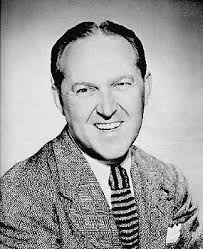 . In his studio, he produced about forty minutes of animation for the first season. Scriptwriter David Gerrold
 suggested that these sequences be reused throughout the episodes, which explains the recurring chases of Marshall, Will, and Holly — often disguised by scenery with trees or bushes to vary the framing.
The animation team was coordinated by Janet Riley and included names such as Gene Warren Jr. , Pete Kleinow
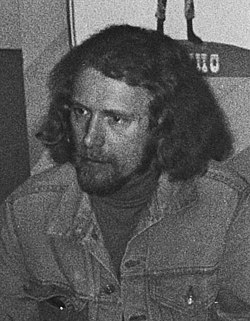 , John Huneck, and Harry Walton
 , who took over much of the work in the third season.
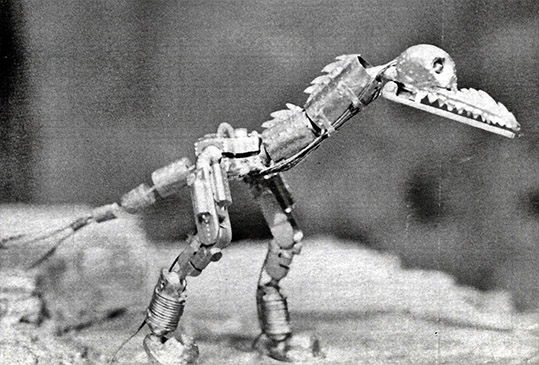
The models used were created by Wah Chang, who reused some puppets from his short film Dinosaurs, the Terrible Lizards (1970). They were small articulated metal skeletons, capable of receiving different “skins” as needed. With rubber foam and latex, a new dinosaur emerged whenever the production required it.
Psychedelic Ruins and the Terror of the Sleestaks
The set design also reinforced the fantastic atmosphere: the ruins of the Sleestak cities were built with simple geometric shapes and translucent plastics. They didn’t need to look old, but rather alien. The lighting in shades of purple and green made the psychedelic nature of the production clear. There were also many matte paintings for background scenery, mostly created by Mike Minor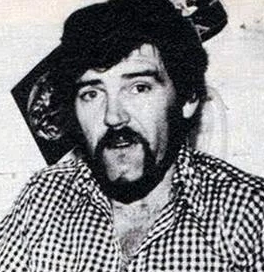 and Gene Warren.
Tall, thin men inside heavy rubber suits became the Sleestaks. The terror effect didn't come from facial expressions — the masks were static, with large, lifeless black eyes — but from the sibilant sound and the slow, choreographed movement. What was lacking in technology was made up for in sound design, imagination, and atmosphere. The problem, a serious one, was that the suits were very tight and hot, causing excessive discomfort for the actors, occasionally leading them to feel unwell.
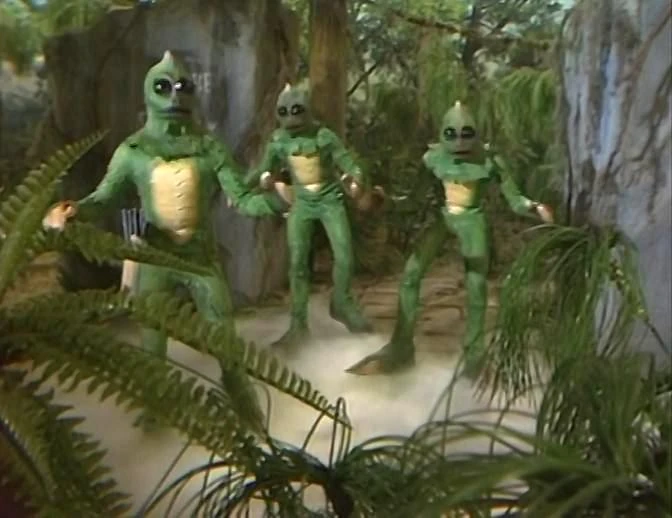
Perhaps the series' greatest "effect" was the courage to be weird. They mixed miniatures, stop-motion animation, studio actors, and video distortion effects to create the portals. It was a visual collage that didn't try to hide its flaws.
The Fading Glow
Just as Méliès saw cinema become too "serious" for his magic tricks, Land of the Lost today inhabits a nostalgic and almost kitsch place2. Over time, the audience began to demand the realism of Jurassic Park.
But there is something heroic about those Saturday mornings. The Kroffts proved that if the story is compelling enough ─even if the acting was sometimes a bit cheesy and forced─ the viewer accepts the pact: I’ll pretend I don’t see the wire holding the Pterodactyl, and you take me to a world where anything is possible through my imagination.
As with every series ─new or old─ there are always behind-the-scenes problems, and Land of the Lost was no different. For example, Spencer Milligan wanted a salary increase after the second season. He didn't get it and left the series. In his place, Uncle Jack (Ron Harper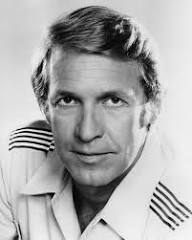 ) appeared. To justify the change at the start of the third season, Rick Marshall finds a portal that takes him back home but leaves his children behind. Through that same portal arrives Uncle Jack, who had been searching for the family since they disappeared.
Whether due to the blue aura around the actors or Grumpy’s nervous roar, Land of the Lost showed that imagination could fill the gaps in technique. For those who want to revisit this charming strangeness, some available materials and episodes follow below.
- Sid & Marty Krofft Website with information on this series and other productions by the duo;
- Land of the Lost Playlist, available on the Tv Classe A channel;
- Land of the Lost Playlist, available on the MyPlaylist BR channel on YouTube;
- Series page on iMDB.
In time...
The 1991 Series: if the original series was psychedelic, the 90s remake was the apotheosis of physical effects. Produced shortly before Jurassic Park changed everything, it used the best of the era:
- Real Animatronics: instead of just Stop Motion, the dinosaurs were complex hydraulic robots or full-scale suits, with much more fluid movements;
- Evolved Chroma Key: The "blue screen" no longer had that blurred aura of the 70s. The integration between actors and miniature sets was almost perfect by TV standards.
The 2009 Film... Not even worth a comment.
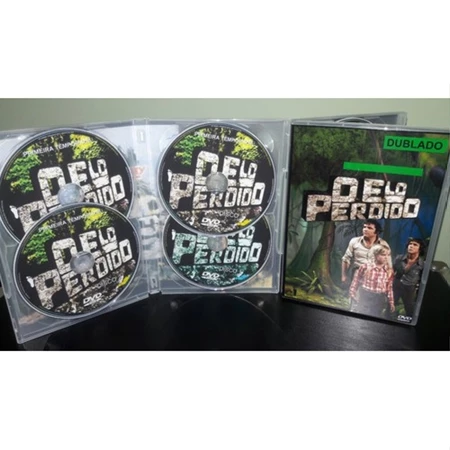
Research sources: Sid & Marty Krofft TV, We Are the Mutants, TvDatabase, Book A Família Marshall e O Elo Perdido (Saulo Adami, 2019, Editora Estronho),