When cinema was still seeking its first narrative forms, contact with death, the supernatural, and the grotesque emerged almost immediately. Bodies moving after the end, religious objects defying their symbolic function, familiar figures transformed into threats —all of this was already appearing on screens in the final years of the 19th century. In this setting of technical experimentation and free imagination, some of the oldest records of silent cinema reveal an early interest in the strange, the macabre, and the unsettling, even when treated with humor or narrative simplicity.
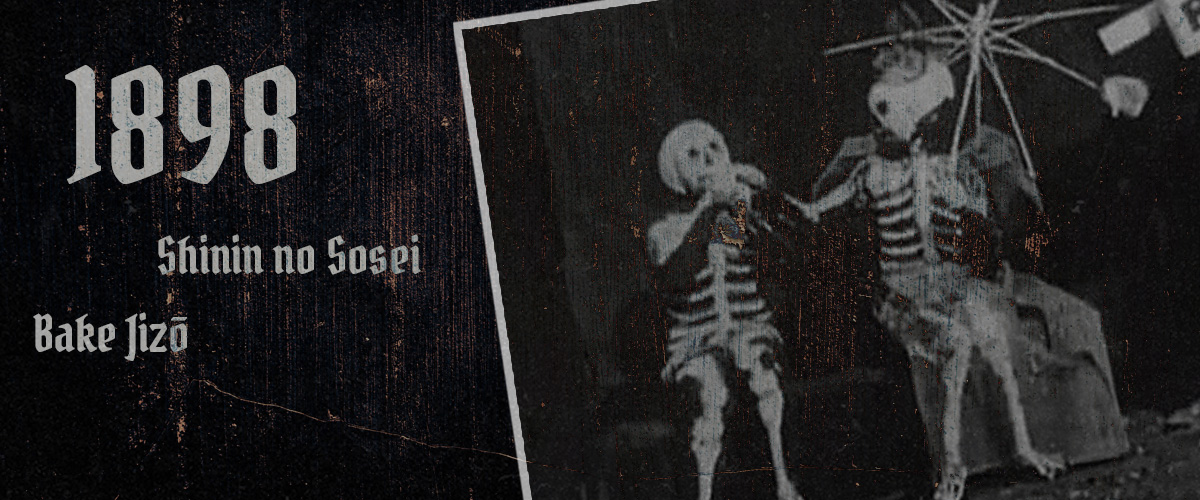
In 1898, two Japanese shorts are frequently cited as some of the first manifestations of horror and the fantastic in the country's cinema: Shinin no Sosei (Resurrection of a Corpse) and Bake Jizō (Jizō the Spook). Both are lost films, known only through historical records, mentions in catalogs, and later accounts. Still, their simple existence says a lot about the early relationship between cinema and death, body and spirituality in late 19th-century Japan.
Shinin no Sosei (1898)
Described as a macabre comedy short, produced by Konishi Honten and directed by Shiro Asano, the film featured a simple and grotesque situation: during a funeral, the bottom of the coffin breaks, the corpse falls out and —unexpectedly— returns to life.
There are no signs of religious solemnity or psychological terror. On the contrary: everything points to a farcical tone, exploring the clash between the ritual of death and the physical absurdity of a moving body. This approach dialogues with Japanese popular theater traditions and the era's taste for exaggerated and disconcerting situations.
Even without surviving copies, Shinin no Sosei is relevant for showing that, in the very first years of Japanese cinema, the corpse was not just a tragic symbol, but also an object of curiosity, nervous laughter, and unease —something cinema would revisit later in much darker forms.
Bake Jizō (1898)
If Shinin no Sosei flirts with black comedy, Bake Jizō dives into the Japanese spiritual imagination. The title refers to Jizō, a central figure in Japanese Buddhism associated with the protection of deceased children, travelers, and souls in suffering. Jizō statues are common on roadsides, in temples, and cemeteries —spaces naturally linked to the transition between worlds.
The term bake suggests transformation or haunting. Thus, the film likely presented the disturbing idea of a sacred statue coming to life, subverting its protective function and taking on an unsettling aspect. It is unknown whether the tone was moralizing, comic, or truly supernatural. But it certainly falls within a Japanese tradition of narratives in which religious or everyday objects animate, revealing hidden intentions.
This theme anticipates, in a rudimentary way, one of the hallmarks of Japanese horror: the ambiguity between the sacred and the threatening, between protection and punishment.
Lost Cinema, Present Horror
Neither of the two films survived. Like much of 19th-century Japanese film production, they disappeared —victims of the fragility of the medium, the lack of preservation, and the perception at the time that cinema was disposable entertainment.
Even so, their importance lies not in the images we cannot see, but in what they represent: the realization that cinematic horror was not born only from European Gothic or Western literature, but also from local traditions, spiritual beliefs, and the universal fascination with the dead body and the afterlife.
These two 1898 shorts are not just archaeological curiosities. They are clear signs that, from its very first steps, Japanese cinema was already flirting with that which disquiets, disturbs, and challenges the boundary between life and death —a path that, decades later, would produce some of the most unique expressions of world horror.
Research sources: iMDB, History of Supernatural Japanese Cinema, Letterbox, EOFFTV, Medium